Can New Gutters Keep Up With Pines and Prairie Storms?
Drive east out of Parker and the land changes fast. Lots open up, ponderosa pines crowd the ridgelines, and the elevation climbs past 6,400 feet as you reach Elizabeth on the edge of the Palmer Divide. That high ground pulls in more snow, more hail and more sudden summer cloudbursts than much of the Denver metro sees.
Gutters out here work harder than the ones on a suburban tract home closer to the city. A system that would be perfectly adequate in Aurora can overflow, sag or clog within a season on a wooded Elbert County lot. The difference rarely comes down to the gutter itself. It comes down to the dozens of small choices made while it goes up.
Homeowners planning Elizabeth gutter installation can lean on Platinum Roofing, a family-run exterior contractor from Greenwood Village that carries a 4.8 Google rating and handles gutter cleaning, repair, replacement and ice dam mediation along with new systems. Because the same crews also work on roofs, they look at how water leaves the shingles before deciding how the gutter should catch it.
It Starts With How Much Water the Roof Sends Down
Every gutter decision follows from volume. Douglas County, Elizabeth’s neighbor to the west, publishes a simple rooftop runoff formula that multiplies roof area by inches of rain by 0.63 to get gallons. Run it on a modest 2,000 square foot roof during a one-inch Palmer Divide downpour and roughly 1,260 gallons pour off in a short burst.
That math is why sizing matters so much. Standard 5-inch K-style gutters handle many homes, but steep roofs, long uninterrupted slopes and valleys that funnel two roof planes into one corner often call for 6-inch gutters. Larger gutters carry about 40 percent more water and give pine debris more room before it backs up.
Seamless Metal Formed in the Driveway
Most quality installs today use seamless aluminum, rolled to length from a coil on a machine parked right at the house. Without joints every 10 feet, there are far fewer places for leaks to start, and fewer seams for ice to pry apart over winter.
Thickness is the detail worth asking about. Thin .027 aluminum dents easily, and on the Palmer Divide that matters, because hail stones that bounce off a Class 4 roof will still crease a lightweight gutter. Heavier .032 aluminum holds its shape better through both hail and snow load. Steel is tougher still but can rust where the finish chips.
Hangers Built for Snow That Sits
A gutter is only as strong as the way it is attached. Hidden hangers screwed through the fascia into the rafter tails beat the old spike and ferrule method, which loosens as wood shrinks and swells. Standard spacing is around every 24 inches, but homes in heavy snow areas do better with hangers closer to every 16 to 18 inches.
Placement on the fascia counts too. Installers should set the gutter low enough that snow sliding off the roof clears the outer lip rather than slamming into it, while still catching normal rain runoff from the drip edge. Before any of that happens, the fascia board itself needs a close look. Soft or rotted fascia will let even perfect hangers pull free, so replacing damaged sections first is part of a proper job.
The Slope Nobody Notices Until It Is Wrong
Gutters have to tilt toward their downspouts, but only slightly. The usual target is about a quarter inch of drop for every 10 feet of run. Too little and water sits, freezes and breeds mosquitoes in summer. Too much and the gutter looks crooked from the street.
Long runs over 40 feet are usually pitched from the middle down to a downspout at each end. Downspouts themselves deserve an upgrade on wooded or steep lots, since larger 3 by 4 inch downspouts swallow pine needles and small cones far more readily than the common 2 by 3 size.
Pine Needles Play by Different Rules
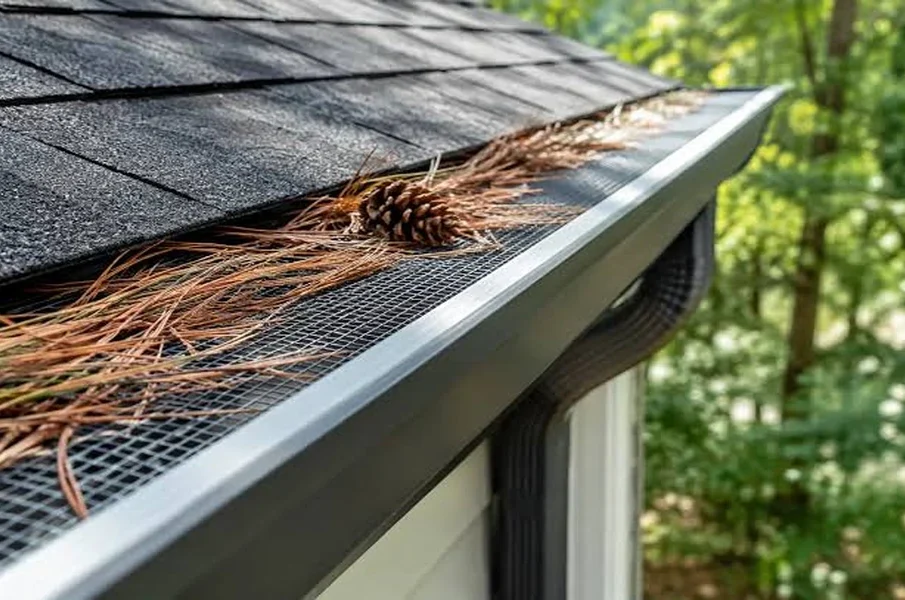
Ponderosa needles are long, stiff and pointed, which makes them slip straight through the large holes of cheap screen guards and lodge upright. Some guard styles cope better than others.
- Stainless steel micro-mesh guards block needles and shingle grit while still letting heavy rain through.
- Reverse curve or surface tension hoods shed debris well but can overshoot water during intense cloudbursts.
- Foam and brush inserts are inexpensive but tend to trap needles and break down under strong high-altitude sun.
- Basic perforated aluminum screens cost little yet often let needles thread right in.
Metal guards also carry a wildfire benefit. Many Elizabeth properties sit in wildland and grassland fire country, and dry needles packed in a gutter can catch blowing embers. Even with good guards, a yearly check and a rinse keep the system flowing.
Where the Water Ends Up on Acreage
Most gutter articles stop at the downspout. Out here, the more important question is what happens after it. Water released right at the foundation can soak the clay-rich soils common along the Front Range, which swell when wet and shrink when dry, pushing on basement walls and slabs.
A good installation carries discharge at least 5 to 10 feet from the house through extensions or buried lines ending in pop-up emitters. Rural homes add another consideration. Downspouts should never be aimed toward a septic leach field or a well head, since extra water can overload the field or carry surface runoff where it doesn’t belong. Gentle swales or rock-lined channels can guide water across a large lot toward open ground.
Some homeowners route a downspout into rain barrels. Colorado allows up to two barrels totaling 110 gallons per household, each with a sealable lid, and the water must be used outdoors on the same property. Barrels should be disconnected over winter so a frozen barrel doesn’t force water back up the downspout.
Ice Along the Eave Each Winter
Gutters do not cause ice dams, but they take the punishment. When attic heat melts snow higher on the roof, that water refreezes in the cold gutter and along the eave, adding weight and forcing moisture under shingles. Heat cables run in a zigzag above the eave and down through the gutter and downspout can keep a melt channel open on problem sections. The lasting fix, though, lives in the attic, where better insulation and ventilation keep the roof surface cold and even.
Built as One System
A gutter that survives Elizabeth weather is never just a metal trough nailed to a board. It is a chain that starts at the roof edge and ends somewhere safely out in the yard, and each link, from gutter size and metal thickness to hanger spacing, pitch, guards and discharge, has to fit the land around it. When those pieces are chosen with pines, hail, heavy snow and open acreage in mind, the gutters fade into the background and simply do their work for decades.